

Carrier Pigeon Apps Roost and Carrier Pidge Surge in Popularity as Users Embrace Slow Messaging Trend
Roost Social and Carrier Pidge offer a nostalgic twist on digital communication, attracting users seeking slower, more intentional interactions.
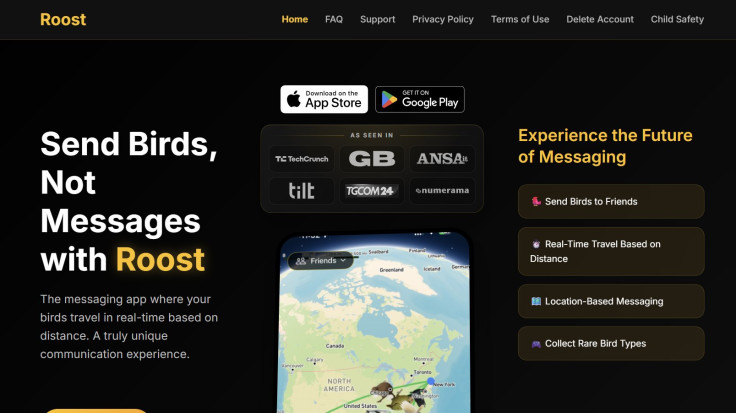
NEW YORK — Two independently developed mobile apps that deliver digital messages at the simulated speed of carrier pigeons have attracted hundreds of thousands of users since their April launches, reflecting a growing appetite for deliberately slower forms of online communication.
Roost Social, created by Logan Mendelsohn, and Carrier Pidge, developed by Noah Iarrobino, function similarly at their core. Users enter their location, compose a message and dispatch it to another app user. The message then travels in real time at a pace approximating how long a bird would take to cover the geographic distance between the two people. There is no instant delivery, no constant notifications and no endless scroll.
As of Aug. 18, Mendelsohn reported that Roost had more than 700,000 users. Iarrobino said Carrier Pidge had reached 76,000 users. Both apps remain free to download and rely on in-app purchases for additional features. Roost is available on both the Apple App Store and Google Play. Carrier Pidge is currently limited to Apple's store.
Mendelsohn, 31, a senior product manager at Ticketmaster who lives in New York, first joked about the concept more than a decade ago. "We were backpacking Europe and I made a joke about, 'Hey, we should make an app to send carrier pigeons to our friends back home and it would be so funny if it took a super long time to get there,'" he told USA TODAY. "I guess since then, it's always been a joke."
He began developing the idea in earnest in May 2025 after posting about it on TikTok, where early reactions were enthusiastic. One commenter wrote, "As a person who loves silly apps but also does the occasional birding, I need this app bad." Mendelsohn released Roost on the Apple App Store on April 30. The app lets users select from a range of birds and other animals, each with speeds based on real-world capabilities. Options include a mallard at 51 mph, a rock dove at 49.5 mph and a red-eared slider turtle at 1 mph. Users start with four animals and can purchase more for between 99 cents and $9.99. The platform also includes mini-games to level up animals and a pen-pal feature that randomly pairs users worldwide.
Iarrobino, 29, a software engineer in Brooklyn, arrived at a nearly identical concept independently and more rapidly. "I was just sitting on my couch one night and the idea just came to me," he said. "I just couldn't get the idea out of my head and that night, I just starting building the project. I just had a big smile on, just laughing the whole time while developing it." He had a working version on the App Store by April 18. Carrier Pidge focuses solely on pigeons, which travel at 110 mph within the app — faster than the 50-60 mph typical of real racing pigeons. Each conversation begins with one pigeon that travels back and forth. There is a 0.2 percent chance the bird dies en route, requiring a 99-cent replacement.
Both developers used artificial intelligence tools extensively. Iarrobino said he first brainstormed with an AI chatbot and then relied on Claude Code, an AI coding assistant released in February 2025, which "wrote a lot" of the app. Mendelsohn wrote the initial code himself but has used Claude Code to resolve issues since launch. He initially incorporated AI-generated artwork, which drew criticism upon release. He has since launched an in-app artist challenge allowing users to submit and vote on original illustrations to replace the AI images.
The two creators were unaware of each other's projects at launch. They have since spoken and agreed that the apps offer distinct experiences despite the shared premise. Running the platforms has proven expensive. Mendelsohn shared Google Cloud billing statements showing more than $10,000 in costs for Roost in July alone and more than $7,600 by Aug. 18.
The apps' appeal aligns with broader trends among younger users seeking less instantaneous digital interactions. Gen Z consumers have shown interest in "dumb phones," some millennials have installed rotary landlines, and companies have marketed tools designed to reduce screen time. Eventbrite previously labeled the warmer months "The Offline Summer." Mendelsohn said conversations with Roost users often center on intentional communication and the absence of noisy feeds or constant alerts. Iarrobino offered a similar observation: "I think people are getting tired of technology being so integrated into our lives, especially a couple years past COVID. People want to get outside, people want to get off of their phones. I think slow messaging kind of helps with that."
Users can track their messages' progress on a map in real time, watching the selected animal make its journey. Delivery times range from minutes for nearby contacts to many hours or even days for longer distances. The deliberate friction is the point. Messages arrive only when the virtual courier does, encouraging users to compose more thoughtfully and to wait without the pressure of immediate replies.
Neither app has affiliation with traditional messaging platforms or major tech companies. Their growth has occurred largely through word of mouth, social media posts and organic interest in slower digital experiences. Mendelsohn continues to manage Roost alongside his full-time role while exploring ways to sustain the service through purchases and potential expansion. Iarrobino has indicated plans to bring Carrier Pidge to Android eventually.
The simultaneous emergence of two nearly identical concepts underscores a shared cultural moment. After years of platforms optimized for speed and constant engagement, a segment of users is actively choosing tools that reintroduce waiting, distance and a measure of unpredictability into everyday communication. Whether the novelty sustains long-term engagement remains to be seen, but the early numbers show that the idea of digital carrier pigeons has clearly taken flight.
© Copyright 2026 IBTimes AU. All rights reserved.