

RingCentral Stock Soars 18% as AI Products Hit $400 Million Run Rate and Profit Beat Lifts Full-Year Outlook
The cloud communications company exceeded quarterly forecasts, raised its 2026 guidance and highlighted rising demand for its artificial intelligence products.
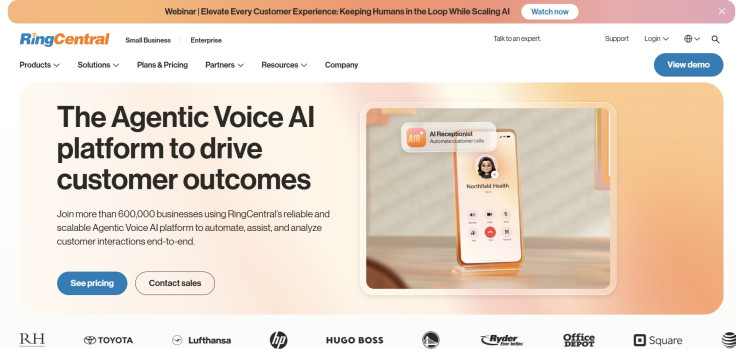
NEW YORK — RingCentral shares jumped more than 18% in early trading Friday. The cloud communications company reported third-quarter profit above Wall Street's forecast, raised its full-year outlook and said its artificial intelligence products have doubled to more than $400 million in annual recurring revenue.
The stock rose $14.73 to $94.13, putting it above its previous 52-week high of $83.72. Shares have gained about 165% over the past year, a sharp recovery from a 52-week low of $24.14.
RingCentral, based in Belmont, California, reported adjusted earnings of $1.33 per share for the quarter ended Sept. 30, beating the analyst consensus of $1.28. Total revenue rose 5.9% from a year earlier to $676 million, and subscription revenue grew 6% to $653 million. Both were above the high end of the company's own guidance.
"We delivered another strong quarter in Q3, with subscription and total revenue above the high end of our guidance," founder and CEO Vlad Shmunis said on a conference call with analysts Thursday.
AI becomes a bigger part of the business
Investors focused on the company's AI products. Customers using at least one paid native AI product now account for about 15% of total annual recurring revenue, or more than $400 million, double the level of a year earlier.
Shmunis said the AI Receptionist product, which answers and routes calls for businesses, now has more than 22,000 customers, nearly four times as many as a year ago. AI Conversation Expert, which analyzes calls, is approaching 7,000 customers. A lighter contact-center product sold as the Customer Engagement Bundle has more than 14,000 paying customers.
"The mega trend of AI represents an even larger opportunity and a powerful tailwind for RingCentral," Shmunis said.
The company said customers who buy AI products spend more per user and stay longer. Retention in that group is above 100%, meaning existing customers in it expand their spending faster than others leave.
President and Chief Operating Officer Kira Makagon said RingCentral released plugins this quarter for OpenAI's ChatGPT and connectors for Anthropic's Claude, so customers can use their call data inside those AI tools.
"RingCentral provides the conversation context, and the AI models provide reasoning," Makagon said.
The company also announced an expanded partnership with the Golden State Warriors, which named RingCentral its official agentic voice AI platform for fan engagement.
Margins and cash flow improve
The quarter showed continued margin gains, which management has emphasized as revenue growth has slowed from earlier years.
Adjusted operating margin rose nearly 2 percentage points to 24.7%. Under standard accounting rules, operating margin reached a record 8%, up 3.2 percentage points, helped by lower stock-based compensation. Free cash flow rose 21% to $157 million.
Reported earnings per share were $6.50. That figure included a one-time, non-cash tax benefit of $545 million. Without it, diluted earnings were 28 cents per share.
"Our core business remains resilient, with growing contributions from our AI portfolio," Chief Financial Officer Vaibhav Agarwal said.
RingCentral also said it has cut gross debt below $1 billion, a goal it reached ahead of schedule. During the quarter it paid off its highest-cost debt, notes carrying an 8.5% interest rate. Net leverage is now 1.3 times, and the company has no debt maturities until 2030.
Guidance raised
For 2026, RingCentral now expects:
Total revenue of $2.650 billion to $2.657 billion Adjusted earnings of $5.07 to $5.12 per share, above the analyst consensus of $5.03 Free cash flow of $620 million to $630 million
For the fourth quarter, it forecast total revenue of $673 million to $680 million and adjusted earnings of $1.32 to $1.37 per share.
The company said it is still targeting a 20% operating margin under standard accounting over the medium term. It also aims to bring stock-based compensation down to 3% to 4% of revenue within three to four years. RingCentral has long been criticized for heavy stock-based pay.
Deals possible, buybacks continue
Asked by a Morgan Stanley analyst how the company would use its stronger balance sheet, Shmunis said RingCentral would mainly build products itself. He said it spends more than $250 million a year on product and technology, but he did not rule out acquisitions.
"So I am not going to tell you that we will never do a sizable acquisition," Shmunis said.
RingCentral bought back about $18 million of stock in the quarter and paid a quarterly dividend of 12.5 cents per share. It has more than $300 million left under its repurchase authorization. Diluted share count fell about 5% from a year earlier.
A rally against a weak market
Friday's gain came as the broader market was under pressure. The Nasdaq had its worst session since June on Thursday, hit by investor concerns about how AI spending is being financed.
RingCentral's stock had fallen 3.6% during Thursday's regular session before the results came out after the closing bell.
The rally adds to a sharp turnaround for RingCentral. The company was hurt for years by slowing growth in its core phone and video business. Its message to investors now centers on profitability, cash returns and AI products that sit on top of its call network. The company says that network handles about 14 billion calls and 4 billion text messages a year.
Some analysts remain cautious about valuation. The stock now trades at more than 60 times trailing earnings, above its five-year median.
© Copyright 2026 IBTimes AU. All rights reserved.