The Top 10 Best Humanoid Robot Manufacturers in 2026: Tesla Optimus, Figure AI and Chinese Leaders Dominate
Humanoid robots are no longer prototypes gathering dust in labs. In 2026, they are clocking shifts on factory floors, unloading trailers and even folding laundry in pilot homes. Global shipments topped 13,317 units in 2025 and are accelerating fast, with Chinese manufacturers claiming 87% of volume while U.S. firms lead on AI sophistication and valuation.

Industry analysts point to a perfect storm: cheaper actuators, vision-language-action models and corporate hunger for labor solutions. Ten companies stand out for blending hardware scale, software smarts and real deployments. Here are the top 10 best humanoid robot manufacturers in 2026, ranked by a mix of shipments, innovation, commercial traction and future potential.
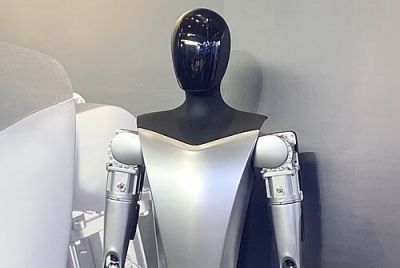
1. Tesla Tesla's Optimus Gen 2 (with Gen 3 pilots underway) remains the most ambitious general-purpose humanoid. Standing 5-foot-8 and weighing 125 pounds, it uses the same neural nets that power Full Self-Driving. The company converted part of its Fremont factory to robot production and aims for 1 million units a year at a $20,000–$30,000 target price. Early factory testing is underway, and public sales are eyed for late 2027. No other player matches Tesla's vertical integration of AI compute, battery tech and manufacturing muscle.
2. Figure AI Valued at $39 billion after a massive 2025 funding round, Figure AI is the darling of big tech. Its Figure 03 humanoid features palm cameras, fingertip sensors detecting 3-gram forces and Helix vision-language-action AI. A landmark 11-month pilot at BMW's Spartanburg, S.C., plant helped build more than 30,000 X3 vehicles, loading 90,000+ parts over 1,250 robot hours. BMW is now expanding trials in Europe with next-generation models. Figure's dedicated BotQ factory targets 12,000 units annually.
3. AGIBOT Shanghai-based AGIBOT is the undisputed volume king. It shipped 5,168 units in 2025 and reached its 10,000th robot by late March 2026 — adding the second 5,000 in just three months. Its A2 full-size and X2 compact models are already in industrial, retail and education deployments across China and made their U.S. debut at CES 2026. Backed by battery giant CATL, AGIBOT also open-sourced the "AGIBOT WORLD 2026" dataset to accelerate embodied AI research. It proves scale and speed can coexist with real-world utility.
4. Boston Dynamics Hyundai-owned Boston Dynamics unveiled its all-electric Atlas at CES 2026, trading hydraulic acrobatics for industrial practicality while retaining legendary agility. The 4-hour runtime and fleet-management Orbit platform position it for warehouse and manufacturing pilots. With 30-plus years of bipedal expertise, the company plans 30,000 units a year. Its shift from viral videos to enterprise-grade reliability cements its place among the elite.
5. Unitree Robotics Unitree's G1, priced at just $13,500, democratized humanoids. The Hangzhou company shipped 4,200 units in 2025 and continues mass production of agile, cost-effective models for logistics and entertainment. Its H1 set running-speed records, and global shipping is routine. Unitree proves high performance need not cost a fortune, pressuring Western rivals on price.
6. Agility Robotics Oregon-based Agility delivered the first commercially deployed humanoid: Digit, now at work in Amazon and GXO Logistics warehouses for case picking and trailer unloading. Its legs-forward design and Agility Arc cloud software solve real material-handling shortages. With $641 million raised, Agility leads in proven ROI for logistics.
7. 1X Technologies Norway's 1X focuses on the home. Its NEO humanoid — lightweight at 66 pounds, 4-hour battery and quiet actuators — is available for pre-order at $20,000 or $499 monthly. OpenAI partnership powers natural conversation and household tasks. While others chase factories, 1X bets the biggest market is inside our living rooms.
8. Apptronik Austin-based Apptronik's Apollo targets 3PL, retail and manufacturing with a 160-pound frame, swappable 4-hour battery and 55-pound payload. Early commercial pilots emphasize injury reduction and repeatable tasks. Its ROI-focused engineering appeals to cost-conscious warehouse operators.
9. UBTECH Shenzhen's UBTECH shipped 1,000 Walker S and Alpha-series units in 2025 for education, elder care and services. Publicly listed and vertically integrated, it balances consumer-friendly pricing with full-size industrial capability — a rare dual-track approach.
10. Sanctuary AI Vancouver's Sanctuary AI stands out for dexterity. Its Phoenix humanoid uses hydraulic hands and embodied AI that mimics human cognition. Microsoft and NVIDIA backing, plus pilot programs, position it for high-precision collaborative work. While smaller in volume, its focus on truly human-like manipulation keeps it on the cutting edge.
The humanoid race is far from over. Goldman Sachs and others forecast the market could reach tens of billions within a decade as robots move from factories into services, health care and homes. Challenges remain — battery life, regulatory approval and ethical questions about job displacement — but 2026 has already shown the technology is no longer experimental.
From Tesla's factory ambitions to AGIBOT's 10,000-unit milestone and Figure AI's BMW production wins, these 10 manufacturers are turning science fiction into shift work. The robots are here. The question now is how fast society adapts.
© Copyright 2026 IBTimes AU. All rights reserved.
- Recommended For You