

PYC Therapeutics Shares Surge 9.4% as RNA Drug Developer Rebounds After Pullback Following Kidney Disease Data
The Perth biotech's stock remains below its yearly high as markets await repeat-dose results from its lead treatment for polycystic kidney disease.
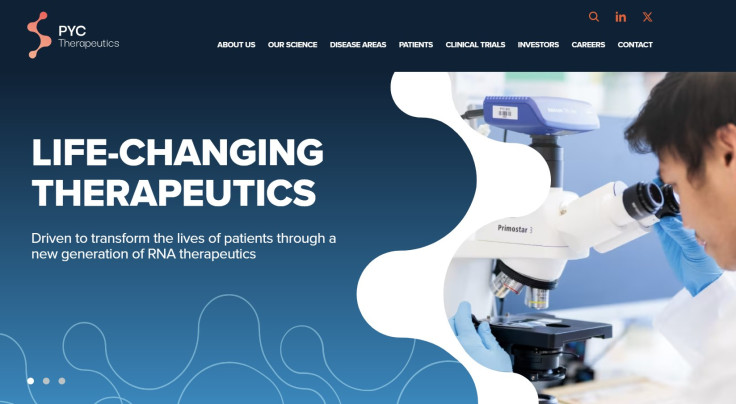
PYC Therapeutics Ltd shares jumped more than 9% on Tuesday, recovering some ground after a sharp pullback. Investors weighed early data from the Perth-based biotech's lead kidney disease drug.
PYC shares rose 16.5 Australian cents, or 9.40%, to close at A$1.92. In the session they traded between A$1.75 and A$1.93. More than 4.3 million shares changed hands, and the company's market value was about A$1.9 billion.
The stock is up about 61% over the past year but remains well below the A$2.93 high it reached earlier this year.
The broader S&P/ASX 200 rose 0.46% to 8,850.1.
PYC did not release any market-sensitive news on Tuesday.
Recent slide
Tuesday's gain followed a steady decline. The shares closed at A$2.39 on Oct. 12, then fell more than 10% the next day ahead of a scheduled data presentation. They slipped further to close at A$1.755 on Monday.
The company presented single-dose data for its lead drug candidate, PYC-003, at the American Society of Nephrology's Kidney Week conference in Denver on Oct. 22.
PYC-003 and ADPKD
PYC-003 is an RNA-based therapy designed to treat autosomal dominant polycystic kidney disease, or ADPKD. In this inherited disorder, fluid-filled cysts grow in the kidneys, causing them to enlarge and eventually fail. It is one of the most common genetic causes of kidney failure.
The drug aims to increase levels of polycystin-1, a protein that is deficient in patients with the disease.
In earlier exploratory data from single-dose Phase 1a/1b studies, the company reported:
A geometric mean increase of 46% from baseline in urinary polycystin-1 at Day 14, in seven patients with usable samples. Measurements of total kidney volume in 18 patients three months after a single dose, compared with a historical benchmark of about 6.2% annual growth in untreated patients.
Total kidney volume is listed by the U.S. Food and Drug Administration as an endpoint that can support accelerated approval for ADPKD treatments.
The company has cautioned that the data were generated "in a small number of patients" and that the findings "need to be reproduced in repeat dose studies" before firm conclusions can be drawn.
Road to registration
PYC is running a Phase 1b multiple-ascending-dose study of PYC-003. Managing Director Rohan Hockings said in September that the company aimed to fully enroll the first two cohorts of 12 patients each by November.
"The objective is to have that initial two cohorts fully recruited by November of this year," Hockings said in a webinar with investors.
The company expects early repeat-dose efficacy data around mid-2027. A registrational readout based on total kidney volume is expected around the end of 2027. PYC has said the FDA has indicated an accelerated approval pathway, with kidney function as a confirmatory measure.
"We are now at what they call the turning of the cards," Hockings said, describing the company's move toward late-stage development.
He also said the company had "the balance sheet strength" to advance several late-stage programs, after raising capital in February.
Broader pipeline
Beyond kidney disease, PYC is developing drugs for:
Phelan-McDermid syndrome, a rare neurodevelopmental disorder, with an investigational new drug filing possible around mid-2027 Autosomal dominant optic atrophy, an inherited eye disease Retinitis pigmentosa type 11, another inherited form of vision loss
The company has said it is preparing for possible U.S. listing requirements but has made no formal decision. "I do not want to preempt a board decision here, and there has been no formal commitment at this stage," Hockings said.
Volatile sector
Small and mid-sized biotech stocks often swing sharply around clinical data, because their valuations depend heavily on trial results. PYC's shares more than doubled over the past year on optimism about its kidney program before the recent pullback.
Some brokers remain positive on the company. Canaccord Genuity has said the stock could more than double from earlier levels, according to market reports.
Investors are expected to focus next on enrollment progress in the multiple-dose study and any further details on the Denver data.
_This article is for information only and does not constitute financial advice._
© Copyright 2026 IBTimes AU. All rights reserved.